
Office Furniture Market Overview
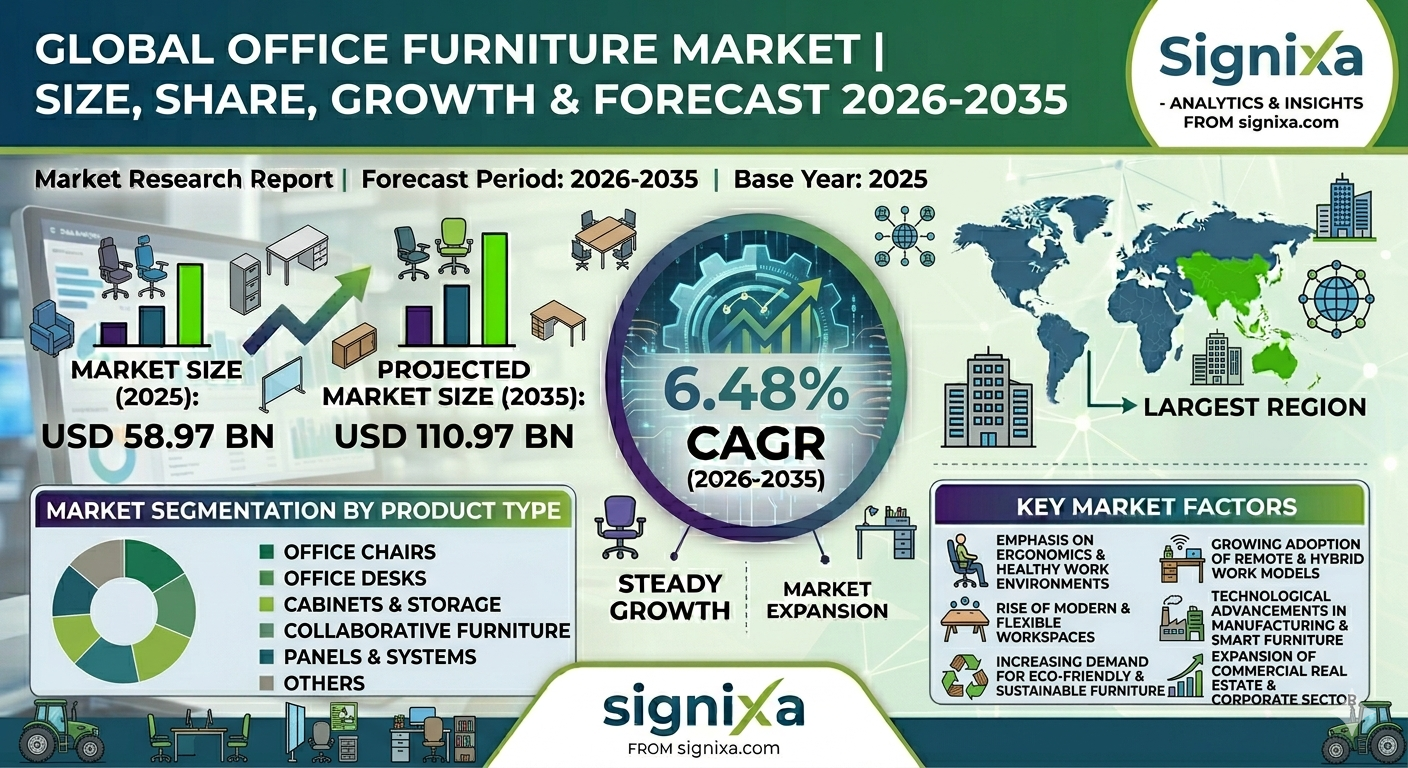
The size of the global office furniture market was worth around USD 58.97 Billion in 2025 and is predicted to grow to around USD 110.97 Billion by 2035, with a compound annual growth rate (CAGR) of roughly 6.48% between 2026 and 2035. The report analyzes the office furniture market's drivers and restraints, as well as the impact they have on demand throughout the projection period. In addition, the report examines global opportunities in the global office furniture market.
The office furniture market includes a wide range of products designed for commercial spaces, including chairs, desks, storage units, and other ergonomic and functional furnishings. Rising demand for flexible and collaborative workspaces, along with the growth of remote and hybrid work models, drives product innovation and design. Office furniture is increasingly tailored for better posture support, aesthetics, and multifunctional use, reflecting shifts in workspace culture and employee well-being trends.
The office furniture market is undergoing a significant transformation, moving beyond mere functional pieces to become integral components of dynamic and adaptable workspaces. This evolution is primarily driven by changing work philosophies, particularly the widespread adoption of hybrid work models. As businesses increasingly embrace flexible arrangements, where employees split their time between the office and remote locations, the demand for versatile and modular furniture solutions has surged. Companies are seeking furniture that can be easily reconfigured to support various work styles, from individual focus work to collaborative team sessions, and that can seamlessly adapt to fluctuating office attendance. This includes modular desks, movable partitions, collaborative seating arrangements, and flexible storage units. The emphasis is on creating agile environments that enhance productivity and foster a sense of community when employees are in the office, while also providing comfortable and ergonomic solutions for home office setups.
Beyond flexibility, a strong focus on employee well-being and productivity is a major overarching theme shaping the office furniture market. Employers are increasingly recognizing the link between a comfortable, healthy work environment and employee satisfaction, engagement, and output. This has led to a significant surge in demand for ergonomic furniture, particularly ergonomic chairs and height-adjustable desks. These products are designed to promote better posture, reduce physical strain, and mitigate the health risks associated with prolonged sitting, such as musculoskeletal issues. Investing in such furniture is seen as a strategic move to improve employee health, reduce absenteeism, and ultimately enhance overall workplace efficiency. The market is also seeing a rise in demand for furniture that integrates features promoting wellness, such as acoustic solutions for noise reduction, biophilic designs that incorporate natural elements, and lighting solutions that support circadian rhythms.
Finally, technological integration and sustainability are becoming crucial drivers within the office furniture market. Modern office furniture is increasingly incorporating smart features like built-in charging ports, wireless connectivity, and even sensors that track occupancy or adjust settings based on user preferences. This integration enhances convenience and productivity in an increasingly digitalized workspace. On the sustainability front, there's a growing imperative for manufacturers to adopt eco-friendly practices. This includes using recycled or sustainably sourced materials, implementing energy-efficient manufacturing processes, and designing furniture for longevity and recyclability at the end of its lifecycle. Both corporate clients and individual consumers are showing a rising preference for "green" furniture, aligning with broader environmental concerns and corporate social responsibility initiatives. This push for sustainable and technologically advanced solutions is not only addressing environmental impacts but also creating new avenues for innovation and differentiation in a competitive market.
Key Findings
- As per the analysis shared by our research analyst, the global office furniture market is estimated to grow annually at a CAGR of around 6.48% over the forecast period (2026–2035).
- In terms of revenue, the global office furniture market size was valued at around USD 58.97 Billion in 2025 and is projected to reach USD 110.97 Billion by 2035.
- The market is projected to grow at a moderate-to-high rate due to rising demand for ergonomic and modular office furniture solutions.
- Based on Product Type, the Office Chair segment is anticipated to hold the largest market share by 2032.
- On the basis of Material, Wood continues to dominate as the preferred choice due to its durability and aesthetic appeal.
- In terms of Distribution Channel, Offline channels account for the major share due to customer preference for physical inspection of products.
- By Region, Asia-Pacific is projected to dominate the global market during the forecast period.
Office Furniture Market Dynamics
Hybrid & Flexible Work Models — Modular, Collaborative & Home Office Demand
The office furniture market is witnessing growth driven by evolving workplace models and the increasing importance of ergonomics. With the hybrid work trend gaining traction, employers are investing in ergonomic solutions to enhance comfort and productivity, both at home and in office settings. This is particularly true in developed markets, where the demand for adjustable chairs, height-adjustable desks, and posture-supporting accessories is rising.
The office furniture market is undergoing a profound transformation, primarily driven by the paradigm shift towards hybrid and flexible work models. The traditional office, once a static entity with assigned desks for every employee, is rapidly evolving into a dynamic hub for collaboration, innovation, and occasional focused work. This transition means that companies are no longer investing solely in individual workstations but are increasingly seeking versatile, modular furniture solutions that can be easily reconfigured to support diverse activities. Demand is surging for collaborative seating arrangements, adaptable meeting pods, movable partitions, and flexible desk systems that can accommodate varying team sizes and work styles. This emphasis on agility extends to the design of entire office layouts, where furniture plays a crucial role in creating zones for different functions — from quiet areas for deep work to vibrant spaces for brainstorming. Furthermore, with employees spending significant time working remotely, there's a parallel increase in demand for ergonomic and functional furniture for home office setups, influencing both B2B and B2C segments of the market.
Co-Working Spaces, SMEs & Smart Feature Integration
Additionally, the increased adoption of co-working spaces and flexible office designs has accelerated demand for modular and space-efficient office furniture. Startups and SMEs are seeking versatile, multi-functional furniture that supports collaboration and easy reconfiguration. Innovations in design, integration of smart features, and customizable products are becoming more common, as businesses prioritize agility, employee satisfaction, and workspace aesthetics.
Employee Well-Being, Ergonomics & Biophilic Workplace Design
Another key dynamic shaping the market is the escalating focus on employee well-being, health, and productivity within the workplace. Businesses are recognizing that investing in ergonomic and comfortable furniture is not just a perk but a strategic necessity for attracting and retaining talent, reducing absenteeism due to musculoskeletal issues, and boosting overall output. This has led to a significant surge in demand for height-adjustable desks, ergonomic chairs with advanced adjustability, and accessories designed to promote good posture and reduce strain. Beyond individual workstations, there's a growing emphasis on creating holistic well-being environments within the office, incorporating elements like biophilic design (integrating natural elements), acoustic solutions to reduce noise pollution, and furniture that supports natural movement. Manufacturers are responding by integrating smart features, such as sensors that track usage patterns or guide users on ergonomic adjustments, further enhancing the health-conscious aspect of office furniture.
Market Challenges — Raw Material Costs, Supply Chain & Sustainability Pressures
However, the office furniture market also grapples with significant challenges, particularly related to raw material costs, supply chain complexities, and intense competition. Fluctuations in the prices of key raw materials like steel, wood, and plastics directly impact manufacturing costs and profitability. Global supply chain disruptions, exacerbated by geopolitical events and logistical challenges, can lead to delays in production and delivery, affecting lead times and customer satisfaction. The market is also highly competitive, with a mix of established global players, regional manufacturers, and an increasing number of online-only brands. This competition puts pressure on pricing and necessitates continuous innovation in design, functionality, and sustainability. Additionally, the growing consumer demand for eco-friendly and sustainable furniture, while an opportunity, also presents a challenge for manufacturers to adopt greener practices, source recycled or renewable materials, and implement circular economy principles, often requiring significant investment and a re-evaluation of traditional manufacturing processes.
Office Furniture Market Segmentation Analysis
By Product Type Segment Analysis: Office Chairs, Tables, Storage & Others
Office Chair
Office Chairs dominate the product segment, accounting for over 35% of the global market in 2025. These products are essential in every workspace, and the growing emphasis on ergonomic support has increased demand for high-back, mesh, and lumbar-support chairs. The surge in hybrid work and home office setups is further amplifying both commercial and consumer demand for ergonomic seating solutions globally.
Office Table
Office Tables, including executive desks and sit-stand desks, are also gaining popularity due to their integration in open and home offices. Height-adjustable desks are among the fastest-growing product sub-categories, driven by growing awareness of the health risks associated with prolonged sitting and employer investment in ergonomic workstations for both office and remote settings.
Storage Furniture
Storage Furniture, comprising cabinets and filing units, holds significant relevance in both traditional and contemporary workspaces. Smart storage designs that integrate mobility, compact form factors, and aesthetic appeal are gaining traction as offices shift toward open-plan and agile layouts that require efficient space utilization and flexible organization systems.
Others (Collaborative & Lounge Furniture)
The 'Others' category covers collaborative furniture used in breakout zones and lounges. This includes modular seating pods, acoustic meeting booths, lounge chairs, and flexible partitioning systems that are becoming increasingly important as offices redesign their layouts to support informal collaboration, creativity, and employee well-being beyond traditional workstations.
By Material Segment Analysis: Wood, Steel & Other Materials
Wood
Wood-based office furniture held over 45% market share in 2025, as it is preferred for its aesthetic versatility, strength, and sustainability. Solid wood and engineered wood are widely used in executive tables, storage units, and chairs. The growing preference for sustainably sourced and FSC-certified wood products is further reinforcing wood's position as the material of choice for premium and eco-conscious office environments.
Steel
Steel furniture, accounting for nearly 30% of the market, is favoured in storage applications due to its durability and sleek appearance, especially in commercial and industrial settings. Steel's strength, fire resistance, and precision manufacturing capabilities make it ideal for filing systems, lockers, and heavy-duty storage in institutional and large corporate environments.
Others (Plastic, Aluminum & Composites)
Other materials, such as plastic, aluminum, and composite materials, are emerging for lightweight and cost-effective solutions suitable for dynamic or shared work environments. These materials are particularly popular in collaborative and flexible workspace settings where furniture needs to be mobile, reconfigurable, and resistant to heavy daily use.
By Distribution Channel Segment Analysis: Online vs. Offline
Offline Distribution
Offline distribution accounted for approximately 65% of the global revenue in 2025, driven by consumers' need to physically inspect furniture before purchase. Brick-and-mortar stores, furniture showrooms, and large retailers provide a touch-and-feel experience and personalized service, which remain crucial for large-scale or high-value purchases. Corporate bulk procurement decisions are typically made through direct sales channels and interior design consultants.
Online Distribution
Online channels, growing at a faster rate, now account for 35% of the market, supported by the increasing use of e-commerce platforms, virtual visualization tools, and doorstep delivery services, especially for modular and ergonomic furniture. The rise of direct-to-consumer (DTC) brands and home office furniture demand during and post-pandemic has significantly accelerated online channel growth globally.
Report Attributes & Market Scope
| Report Attribute | Details |
|---|---|
| Market Size Value in 2025 | USD 58.97 Billion |
| Market Size Value in 2035 | USD 110.97 Billion |
| CAGR (2026–2035) | 6.48% |
| Base Year Used for Estimation | 2025 |
| Historic Data | 2020-2025 |
| Forecast Period | 2026-2035 |
| Segments Covered -By Product Type |
|
| Segments Covered -By Material |
|
| Segments Covered -By Distribution Channel |
|
| Regions Covered | North America, Europe, Asia Pacific, Latin America, Middle East and Africa |
| Major Countries Covered | U.S., Canada, Mexico, Germany, UK, France, Italy, Spain, Russia, China, Japan, South Korea, India, Southeast Asia Countries, Brazil, Argentina, GCC Countries, Turkey, Iran, Israel, South Africa, Egypt, Nigeria, etc. |
| Key Companies Profiled | Steelcase, Herman Miller, Haworth Inc., HNI Corporation, Knoll Inc., Teknion Corporation, Kimball International, Okamura Corporation, KOKUYO Co., Ltd., and IKEA, among others. |
Office Furniture Market Regional Analysis
Asia-Pacific leads the global office furniture market, accounting for over 40% of the global share in 2025. The region's growth is driven by rapid urbanization, expansion of the corporate sector, and increasing investment in commercial infrastructure in countries like China, India, and Southeast Asia. North America ranks second, supported by high spending on office renovations, adoption of advanced ergonomic designs, and the hybrid work trend. Europe holds a steady share, with demand focused on sustainable and design-centric furniture. Latin America and the Middle East & Africa are emerging markets, driven by growing office construction and infrastructure investments.
Asia-Pacific
The Asia Pacific region represents the largest and fastest-growing market for office furniture globally, fuelled by rapid urbanization, significant economic growth, and a burgeoning corporate sector, particularly in countries like China, India, and Southeast Asia. The expansion of commercial real estate, coupled with the proliferation of new businesses and multinational corporations, directly translates into a soaring demand for new office furniture. While traditional office setups remain prevalent, there's a strong and accelerating trend towards modern, ergonomic, and technologically integrated furniture, mirroring global best practices. The high cost of urban real estate in major Asian cities also drives demand for space-saving and multifunctional furniture solutions. Furthermore, the increasing awareness of employee well-being and productivity is leading companies to invest in ergonomic seating and height-adjustable desks. The region's strong manufacturing capabilities and competitive pricing also make it a significant hub for both domestic consumption and global exports of office furniture.
North America (2nd Largest)
North America's office furniture market is undergoing a significant transformation, driven by the widespread adoption of hybrid and flexible work models. This shift has led to a dual demand: on one hand, companies are redesigning their physical office spaces to be more collaborative, versatile, and amenity-rich, requiring modular desks, flexible seating arrangements, and collaborative pods. On the other hand, the surge in remote work has fuelled a substantial demand for home office furniture, with individuals investing in ergonomic chairs, height-adjustable desks, and compact storage solutions to create productive and comfortable workspaces at home. The region also exhibits a strong emphasis on employee well-being, leading to increased adoption of ergonomic designs and furniture that promotes movement and health. Sustainability is another key driver, with a growing preference for eco-friendly materials and manufacturing processes. The robust IT sector and numerous startups further contribute to the demand for modern, technologically integrated, and adaptable office furniture solutions across the US and Canada.
Europe
Europe's office furniture market is highly influenced by its diverse economies, evolving workplace regulations, and a strong cultural appreciation for design and ergonomics. The emergence of hybrid working models is a significant trend across the continent, prompting companies to rethink office layouts and invest in flexible furniture that supports both individual focus and teamwork. There's a notable emphasis on creating aesthetically pleasing and inspiring office environments, with a strong demand for stylish, modern, and high-quality furniture that integrates seamlessly into contemporary interior designs. Sustainability is a paramount concern in Europe, with a high demand for eco-friendly materials, circular economy principles in furniture manufacturing, and adherence to stringent environmental certifications. The market is also characterized by a robust network of specialized furniture dealers and an increasing shift towards online sales channels, catering to both large corporate clients and small to medium-sized enterprises (SMEs) seeking adaptable and health-conscious office solutions.
Middle East & Africa
Latin America
Latin America is an emerging market for office furniture, driven by growing office construction and infrastructure investments across the region. Brazil and Mexico are the largest markets, supported by expanding corporate sectors, rising foreign direct investment, and the growth of professional services industries. The region is also experiencing growing demand for co-working spaces as entrepreneurs and freelancers seek flexible office solutions. While price sensitivity remains a factor, increasing exposure to international workplace design trends and growing corporate investment in employee experience are gradually elevating demand for premium ergonomic and modular office furniture solutions.
Recent Developments in the Office Furniture Market
-
2023
Steelcase introduced a new line of eco-friendly, modular workstations aimed at hybrid offices, featuring reconfigurable components made from recycled materials and designed to support the evolving range of work activities -from focused individual tasks to collaborative team sessions -in a single adaptable workspace footprint.
-
2022
IKEA expanded its ergonomic office furniture offerings with smart features including integrated charging and adjustable configurations, making advanced ergonomic solutions more accessible to home office users and smaller businesses at competitive price points across its global retail network.
Office Furniture Market: Competitive Landscape
The global office furniture market features major players such as Steelcase, Herman Miller, Haworth Inc., HNI Corporation, Knoll Inc., Teknion Corporation, Kimball International, Okamura Corporation, KOKUYO Co., Ltd., and IKEA. Leading companies are focusing on sustainable designs, ergonomic innovation, and modular product lines to meet evolving workspace needs. Competitive strategies include partnerships with workspace designers, expansion into emerging regions, and investment in smart and connected furniture. The push toward personalization, comfort, and flexible office setups is intensifying product development and portfolio diversification across the competitive landscape.
The competitive landscape of the office furniture market is highly diverse and dynamic, characterized by a blend of well-established, globally recognized manufacturers and a rapidly growing number of agile, specialized firms. Large, incumbent players leverage their extensive manufacturing capabilities, vast distribution networks, and strong brand legacies to maintain significant market share. Their competitive strategies often revolve around offering comprehensive product portfolios, ranging from traditional executive office suites to modern collaborative workstations, catering to a wide array of corporate clients. These companies also invest heavily in research and development to drive innovation in ergonomics, smart furniture integration, and sustainable materials. Their ability to manage complex global supply chains and achieve economies of scale provides a significant cost advantage, allowing them to serve large-scale projects and maintain competitive pricing. However, they face the challenge of adapting quickly to rapidly evolving workplace trends and changing aesthetic preferences, sometimes struggling to offer the same level of customization or niche solutions as smaller players.
The market's competitiveness is further intensified by the rise of direct-to-consumer (DTC) brands, particularly those catering to the burgeoning home office segment, and a strong emphasis on sustainability and employee well-being. DTC companies can offer competitive pricing by cutting out traditional retail intermediaries and often differentiate themselves through unique designs, targeted marketing, and a focus on specific niches, such as ergonomic solutions for remote workers. Many of these newer entrants also prioritize sustainability, using eco-friendly materials and transparent manufacturing processes, which resonates strongly with environmentally conscious corporate and individual buyers. This emphasis on well-being and sustainability is pushing all market participants to innovate, leading to a proliferation of height-adjustable desks, ergonomic chairs with advanced features, and furniture made from recycled or rapidly renewable resources. Ultimately, competition is less about price wars and more about value proposition, encompassing product innovation, design aesthetics, ergonomic benefits, sustainability credentials, and the ability to offer flexible solutions that support the evolving landscape of work.
Key Companies Profiled
Global Office Furniture Market Segmentation Summary
By Product Type
By Material
By Distribution Channel
By Region
Frequently Asked Questions (FAQs): Office Furniture Market
What is office furniture?
Office furniture includes desks, chairs, storage units, and other furnishings used in workplaces to support various professional activities, including sitting, writing, storing files, collaborating, and organizing workspaces efficiently.
Which key factors will influence the office furniture market growth over 2026-2035?
The global office furniture market will grow due to rising demand for ergonomic and modular furniture, expansion of commercial real estate, adoption of hybrid work models, and increased awareness of employee well-being and workspace aesthetics.
What will be the value of the office furniture market during 2026-2035?
According to the study, the global office furniture market size was worth around USD 58.97 Billion in 2025 and is predicted to grow to around USD 110.97 Billion by 2035.
What will be the CAGR value of the office furniture market during 2026-2035?
The CAGR value of the office furniture market is expected to be around 6.48% during the forecast period from 2026 to 2035.
Which region will contribute notably towards the office furniture market value?
The Asia-Pacific region will lead the global office furniture market due to rapid urbanization, rising corporate sector investments, and growing demand for commercial and co-working spaces in countries like China, India, and Southeast Asia.
Which are the major players leveraging the office furniture market growth?
The global office furniture market is driven by companies such as Herman Miller Inc., Steelcase Inc., Haworth Inc., Knoll Inc., Teknion Corporation, Kimball International, Inc., Okamura Corporation, HNI Corporation, Global Furniture Group, and KOKUYO Co., Ltd.
What can be expected from the global office furniture market report?
The report offers a comprehensive overview of the office furniture market, detailing current growth drivers, restraints, opportunities, and challenges. It includes market size, competitive landscape, segmentation by product, material, and channel, along with regional insights and future outlook.